
The Leasehold and Freehold Reform Act 2024 was supposed to be the turning point. After decades of campaigning, leaseholders were promised the abolition of marriage value, 990-year lease extensions, and a standardised valuation method that would make extending a short lease dramatically cheaper. Nearly two years later, those provisions remain uncommenced. And now a legal challenge from some of Britain's wealthiest landowners threatens to push them back even further.
The Court of Appeal has granted freeholders permission to appeal a High Court ruling that backed the reforms. Here is what happened, what it means, and what short lease flat owners should be thinking about right now.
What the freeholders are challenging
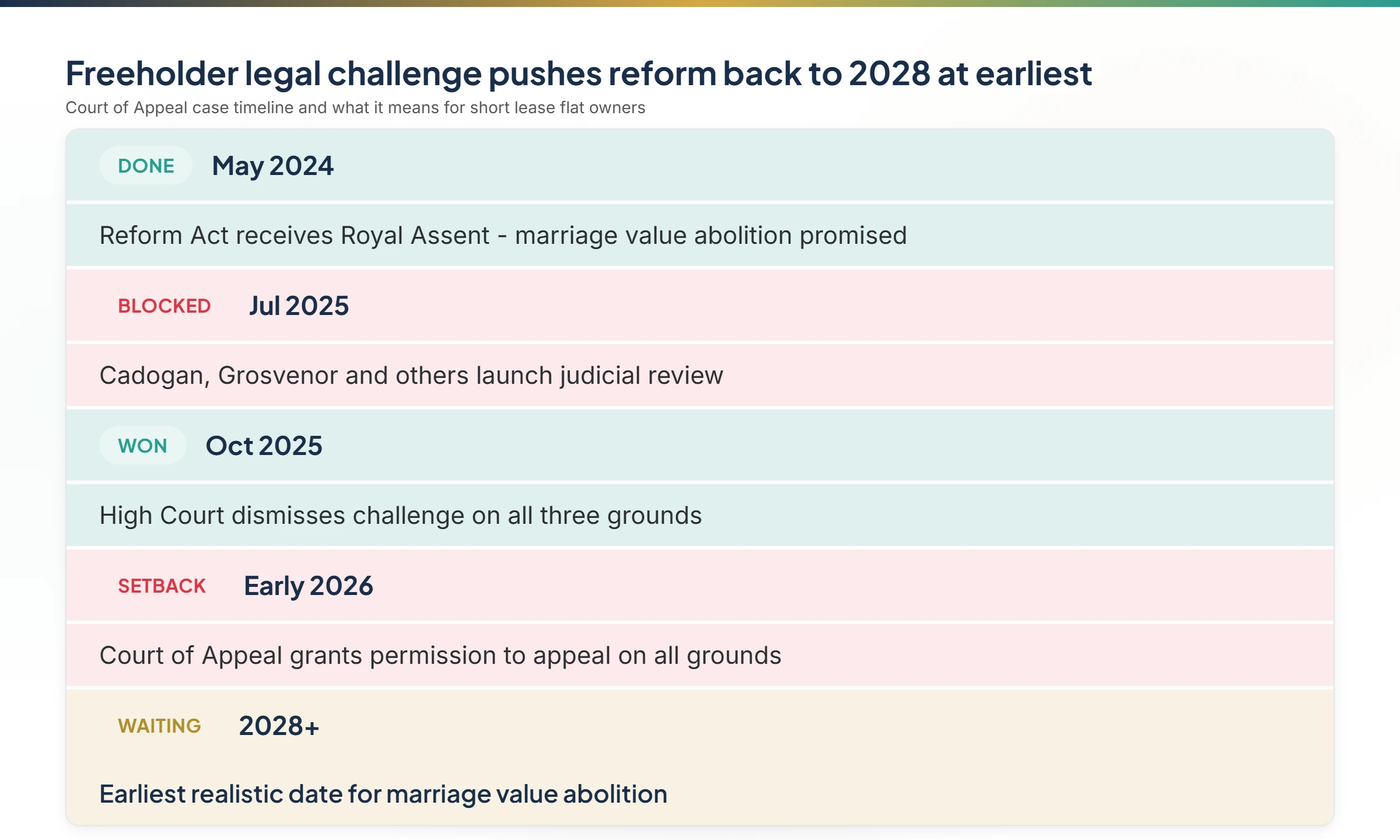
In July 2025, a consortium of six major freeholders - including Cadogan Estates, Grosvenor Group, and the Howard de Walden Estate - launched a judicial review of the Act. Their argument: that removing marriage value, capping ground rents, and restricting their right to recover legal costs from leaseholders amounts to an unlawful interference with their property rights under Article 1 of Protocol 1 of the European Convention on Human Rights.
They targeted three specific provisions:
- The abolition of marriage value - the freeholder's 50% share of the value uplift when a lease below 80 years is extended
- The cap on ground rent that can be factored into lease extension premiums
- The removal of the freeholder's right to charge leaseholders their legal and surveyor costs during the extension process
In plain terms: the freeholders argue the Act takes too much from them, too fast, without fair compensation. They want the courts to strike down or soften these provisions before they ever come into force.
What has happened so far
On 24 October 2025, the High Court dismissed the challenge on all three grounds. The judges ruled that Parliament was entitled to reform a system that had fundamental defects, even at the expense of freeholders. The reforms, they found, pursued a legitimate public interest and were proportionate.
That looked like the end of it. One of the six claimants - John Lyon's Charity - announced it would not pursue the case further and accepted the ruling.
But the remaining five did not. In November 2025, they sought permission to appeal. And in early 2026, the Court of Appeal granted that permission on all grounds.
Why this matters for short lease flat owners
The appeal does not change the law as it stands today. The Act is still on the statute book and the Government still intends to implement it. But the appeal creates serious uncertainty about when that will happen.
Legal experts estimate the appeal process will take 9-12 months, with a hearing likely in late 2026. If the freeholders lose again, they could seek to take the case to the European Court of Human Rights in Strasbourg - a process that could add years.
Meanwhile, the Government has been clear that it will not commence the most significant provisions - marriage value abolition, the new valuation methodology, and 990-year extensions - while the legal challenge is ongoing. The practical result: short lease flat owners who were counting on cheaper extensions by late 2026 are now looking at 2028 at the earliest.
For an owner with a lease at 75 years, that means three more years of depreciation under the current rules. Every year below 80 accelerates the discount. A flat worth £400,000 on a long lease could lose £15,000-£25,000 in value over those three years simply through lease decay. That is not a theoretical cost - it is the gap between what the flat would sell for today and what it will sell for if nothing changes.
What should you do now?
There is no single right answer. It depends on where your lease sits and how urgently you need to act. But here are some practical guidelines:
- If your lease is between 80-85 years - you are close to the cliff edge. Waiting for reform means risking falling below 80 years, which triggers marriage value under current rules and adds tens of thousands to your extension cost. Extending now, while marriage value does not apply, is likely the safer bet.
- If your lease is well below 80 years - you are already paying marriage value under today's rules. The longer you wait, the more expensive the extension becomes. Whether you extend now or sell as-is depends on your financial position and how long you can afford to hold.
- If you are thinking of selling - do not assume reform will arrive before you need to move. The timeline is unreliable. Selling to a cash buyer who understands short lease valuations may be the most practical route to certainty.
For a detailed breakdown of the current rules and their status, see our guide to which provisions are in force. If you are considering a lease extension under the current system, our Section 42 notice guide explains the process step by step.
And if you want to know what your short lease flat is worth today - not in some uncertain future after reform - get in touch. We buy short lease flats across London and can give you a straightforward, honest assessment.