
If you own a flat on a short lease, ground rent and service charges are probably two of your least favourite line items. They eat into your budget, they feel out of your control, and in some cases they have been rising at rates that far outstrip inflation. The good news is that the law is catching up. Between the Leasehold Reform (Ground Rent) Act 2022 and the Leasehold and Freehold Reform Act 2024 (LAFRA), there are real changes either already in place or on the way.
The bad news? Not all of these reforms have landed yet. Here is a clear summary of what has changed, what is still pending, and what it all means if you are thinking about holding onto or selling a short lease flat.
Ground rent - what has changed
Ground rent reform has come in two stages, and there is still a third stage that leaseholders are waiting for.
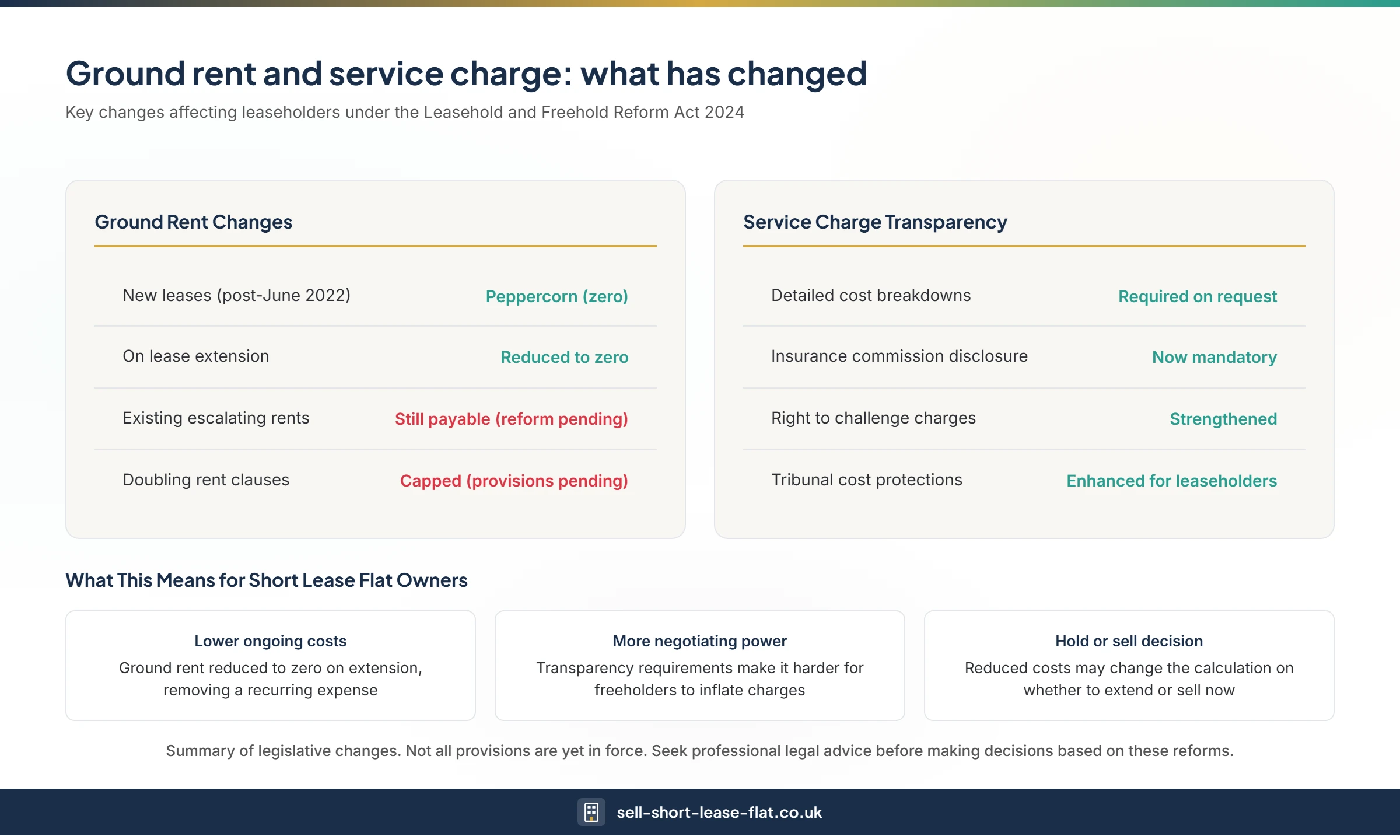
The first stage was the Leasehold Reform (Ground Rent) Act 2022, which came into force on 30 June 2022. This set ground rents to zero (a peppercorn) on all new residential leases granted from that date. If you bought a newly built flat after June 2022, your ground rent should be nil. You can read the full detail in the Gov.uk guidance on the Leasehold Reform (Ground Rent) Act 2022.
The second stage comes through LAFRA 2024. When you extend your lease under the new provisions, the ground rent on the extended lease will be reduced to a peppercorn automatically. This is a meaningful shift for short lease flat owners considering extension. Under the old rules, an informal lease extension negotiated directly with the freeholder might still include a ground rent - sometimes an escalating one. The statutory route always produced a peppercorn rent on the extended portion, but the new rules make this universal and remove any ambiguity.
Here is where it gets frustrating. The third stage - capping or abolishing ground rents on existing leases that have not yet been extended - has not been implemented. If you are currently paying £500 or £1,000 a year in ground rent under an older lease with a doubling clause or RPI-linked escalation, those payments continue. The Government has signalled its intention to act on this, but the secondary legislation has not materialised. For owners of short lease flats with high ground rents, this is a real financial burden that remains unresolved.
Service charge transparency reforms
Service charges have been a source of tension between leaseholders and freeholders for decades. The sums involved are often substantial - particularly in London, where annual service charges of £3,000-£5,000 are common, and some developments run into five figures. Until recently, challenging those charges meant navigating an opaque process with limited information.
LAFRA has introduced several changes that are now in force:
- Detailed breakdowns required. Freeholders and managing agents must now provide itemised service charge accounts in a standardised format. No more vague single-line entries for "maintenance" or "general upkeep." You are entitled to see exactly what was spent and where.
- Insurance commission disclosure. This is a big one. For years, some freeholders and managing agents earned significant commissions - sometimes 30-40% of the premium - by placing buildings insurance through preferred brokers. Those costs were passed straight through to leaseholders via the service charge. Full disclosure of insurance commissions is now mandatory, and the ability to recover inflated premiums has been restricted.
- Strengthened right to challenge at tribunal. Leaseholders always had the right to challenge unreasonable service charges at the First-tier Tribunal (Property Chamber). But the process carried risk, because many leases included clauses requiring the leaseholder to pay the freeholder's legal costs - win or lose. LAFRA has enhanced cost protections, limiting the circumstances in which freeholders can recover their legal costs from leaseholders who bring challenges. This makes it significantly less intimidating to hold your freeholder to account.
These reforms are already making a difference. Managing agents are having to tighten up their reporting, and the insurance changes alone could save leaseholders hundreds of pounds a year. For anyone paying a large service charge on a short lease flat, this is worth paying attention to.
How this affects the hold-or-sell decision
If you own a flat with a short lease, you are constantly weighing up the same question: extend, sell, or wait? These reforms shift the calculation, but not in a straightforward way.
On the positive side, the ground rent changes improve the economics of extending. If you extend your lease, the new ground rent will be zero - removing an ongoing cost that, under some older leases, was set to escalate significantly over the coming decades. Combined with the service charge transparency rules, your total holding costs as a leaseholder should become more predictable and potentially lower.
But there are complications. If your lease is already short - say below 70 years - most mainstream lenders will not offer a mortgage against it. That limits your pool of buyers if you decide to sell on the open market. Extending first to make the flat mortgageable is the textbook advice, but extension still costs money. Under the current rules (with marriage value still payable on leases below 80 years and LAFRA's abolition of marriage value not yet in force), that cost can be substantial.
Then there is timing. The reforms are coming in stages, and some of the most valuable provisions - particularly the abolition of marriage value and the cap on existing ground rents - remain pending. If you are holding on in the hope that those provisions will be enacted soon, you are taking a risk. Your lease gets shorter every day. A flat with 70-80 years remaining typically trades at a 5-15% discount to long-lease value. At 60-70 years, that discount widens to 15-30%. Below 60 years, you are looking at 30% or more.
For some owners, the practical reality is that selling now - even at a price below full market value - makes more sense than waiting for reforms that may be months or years away. That is especially true if you need to release equity, if you are dealing with escalating ground rents that have not been capped, or if your flat is becoming harder to sell as the lease ticks down.
If you are considering your options, our lease extension advice page covers the costs and process in detail, and our guide to buying the freehold vs extending your lease walks through the trade-offs.
What to watch for
The reform landscape is still shifting. Here are the key things to keep an eye on:
- Capping existing ground rents. The Government has committed to addressing escalating ground rents on existing leases, but the mechanism and timeline remain unclear. If you are paying high ground rent under an older lease, this is the provision that will matter most to you - and it is the one with the least certainty around delivery.
- Marriage value abolition timeline. LAFRA abolishes marriage value on lease extensions, but this provision is not yet in force. When it is enacted, it will remove the single largest cost component for anyone extending a lease below 80 years. The interaction between this and the ground rent reforms will determine the total cost of extending.
- Managing agent behaviour. The service charge transparency rules are in force, but enforcement is another matter. Watch whether your managing agent is actually complying - providing proper breakdowns, disclosing insurance commissions, and responding to information requests within the required timeframes. If they are not, the strengthened tribunal protections give you more options to push back.
- Prescribed valuation rates. The Government is still consulting on the capitalisation and deferment rates that will be used in the new standardised lease extension calculation. The final numbers will determine whether the new method delivers meaningful savings beyond the removal of marriage value.
These reforms are broadly positive for leaseholders, but they are not a reason to sit on your hands if your lease is getting critically short. The value of your flat erodes with every year that passes, and no reform can give you that time back.
If you want a clear picture of where you stand, get in touch. We work with short lease flat owners every day and can give you an honest assessment of your options - whether that is extending, selling, or waiting.