
Almost two years after the Leasehold and Freehold Reform Act 2024 received Royal Assent, leaseholders are understandably frustrated. The Act promised the most significant overhaul of leasehold law in a generation, but implementation has been slow and uneven. Some provisions are already making a difference. Others - including the changes that matter most for short lease flat owners - remain stuck in a legislative holding pattern.
Here is a straightforward breakdown of where things stand as of April 2026.
What has changed so far
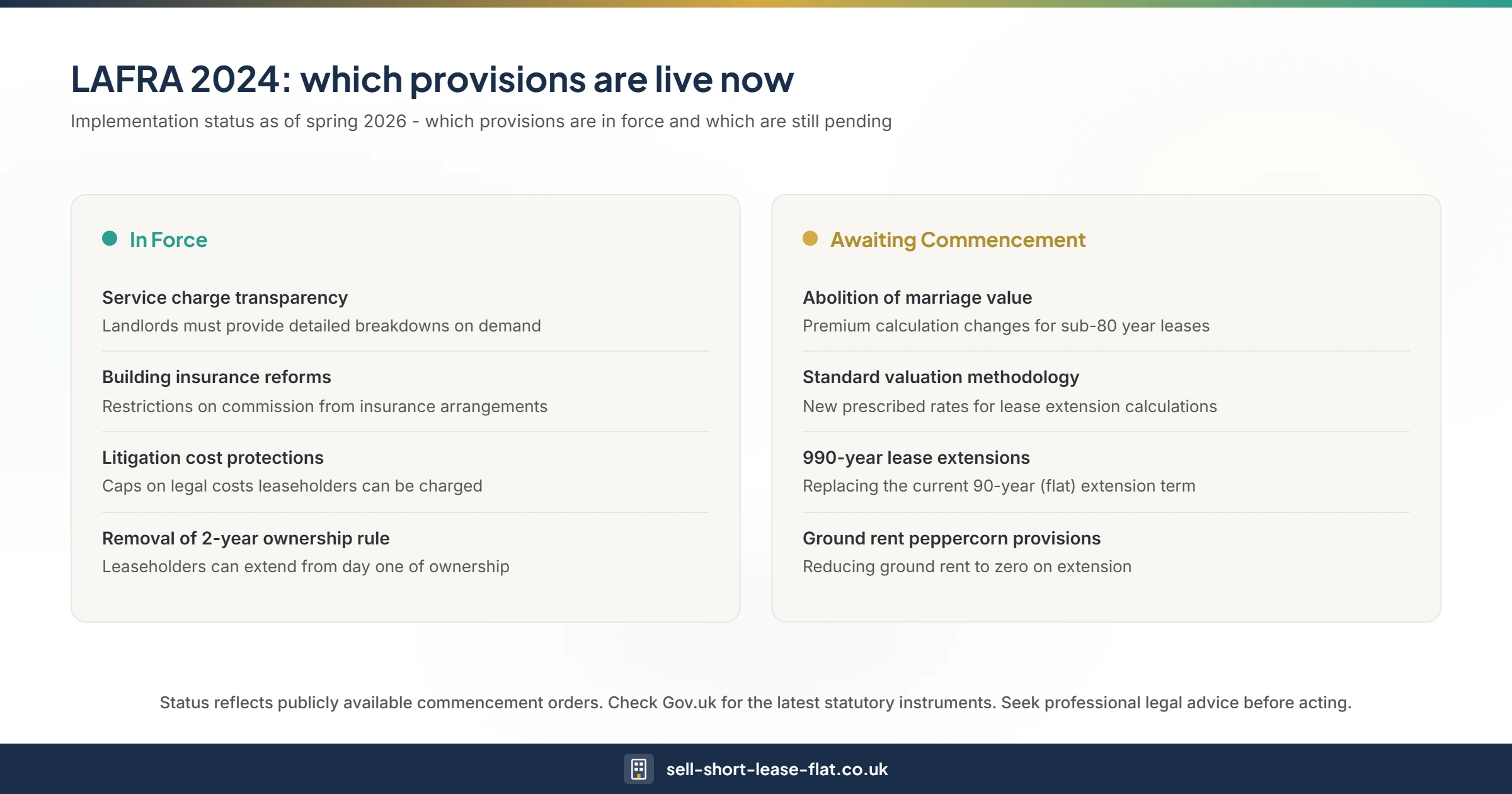
Four sets of provisions from the Act are now in force. They are not the headline-grabbing reforms, but they do make a practical difference.
Removal of the two-year ownership rule
This came into force on 31 January 2025 and was the first provision to be implemented. Previously, you had to own your flat for at least two years before you could serve a Section 42 notice to begin a statutory lease extension. That rule caused real hardship - if you bought a flat with a short lease, you were forced to sit and watch the lease tick down for two years before you could do anything about it.
That barrier is gone. You can now serve notice to extend your lease from day one of ownership. For anyone buying a short lease flat, this is a genuine improvement.
Service charge transparency
New rules around service charge transparency are now in effect. Freeholders and managing agents must provide more detailed breakdowns of service charge expenditure, respond to requests for information within set timeframes, and make accounts available in a standardised format. The aim is to make it harder for freeholders to hide unreasonable charges in opaque annual statements.
Building insurance reforms
Provisions addressing buildings insurance commissions have also been brought into force. For years, some freeholders and managing agents earned significant commissions from placing buildings insurance - costs that were passed on to leaseholders through the service charge. The new rules require full disclosure of insurance commissions and restrict the ability to pass inflated premiums through to leaseholders.
Litigation cost protections
The Act introduced new protections around legal costs in leasehold disputes. Previously, many lease agreements included clauses requiring leaseholders to pay the freeholder's legal costs when challenging service charges or other issues at the First-tier Tribunal. The implemented provisions limit the circumstances in which these costs can be recovered, making it less risky for leaseholders to challenge unfair charges.
What is still pending
The provisions that will have the greatest financial impact for short lease flat owners have not yet been brought into force. All of them require secondary legislation that the Government is still developing.
Abolition of marriage value
This is the big one. Under the current system, if your lease has fewer than 80 years remaining, extending it triggers marriage value - a payment to the freeholder worth 50% of the increase in your flat's value that the extension creates. For a London flat worth £400,000 on a long lease with 65 years remaining, the marriage value component alone might be £25,000-£35,000.
The Act abolishes marriage value entirely. When implemented, this will remove the single largest cost in extending a short lease. But it is not in force yet. As of April 2026, the secondary legislation needed to bring this provision into effect has not been laid before Parliament. Every lease extension completed today still includes marriage value if the lease is below 80 years.
Standard valuation methodology
Currently, calculating a lease extension premium involves negotiation between two surveyors who may arrive at figures 30% apart, leading to expensive tribunal hearings. The Act introduces a standardised calculation with prescribed capitalisation and deferment rates. The Government is still consulting on what those rates should be - and the final numbers will determine whether the new method delivers meaningful savings beyond the removal of marriage value.
990-year extension terms
The current statutory extension adds 90 years to your remaining lease. The Act increases this to 990 years, bringing flat leases in line with modern new-build terms. While the practical difference between a 90-year extension and a 990-year one is minimal for most owners, the change signals a move towards effectively permanent tenure. This provision awaits commencement alongside the valuation reforms.
Ground rent reduction to peppercorn on extension
When the new rules come into force, any lease extension will automatically reduce the ground rent to a peppercorn (zero) for the extended term. The Leasehold Reform (Ground Rent) Act 2022 already capped ground rents on new leases granted after 30 June 2022, but existing leaseholders with escalating ground rent clauses - some paying £1,000 per year or more - are still waiting for relief. The mechanism for capping ground rents on existing leases (separate from the extension provision) is also still being finalised.
What should short lease flat owners do now?
The pending abolition of marriage value could save flat owners with sub-80-year leases significant sums. For some, waiting could mean keeping £20,000-£40,000 in their pocket. That is a compelling reason to hold off on extending - if you can afford to wait.
But there is a catch. Your lease gets shorter every day, and every year that passes erodes your flat's value. The impact is not linear - it accelerates as the lease gets shorter. A flat with 70-80 years remaining typically sells at a 5-15% discount to its long-lease value. At 60-70 years, that discount widens to 15-30%. Below 60 years, you are looking at 30% or more off the long-lease value.
If your lease is at 82 years and you wait two years for reforms that may or may not arrive on schedule, you could cross below 80 years - triggering marriage value under the current rules and adding tens of thousands of pounds to your extension cost. That is the worst possible outcome.
There is no single right answer. It depends on your lease length, your financial position, and how urgently you need to act. Here are some practical guidelines:
- Lease above 80 years but approaching it - consider extending now under the current rules. The certainty of avoiding marriage value today may be worth more than the possibility of savings from reforms with no confirmed date.
- Lease well below 80 years, no plans to sell soon - you may benefit from waiting if you can absorb the continued lease depreciation. Marriage value abolition could save you the most in this bracket.
- Lease below 80 years and you need to sell - waiting for reforms that have no firm implementation date is not realistic if you need to move. Selling to a specialist buyer who understands short lease valuations may be the most practical route.
For a detailed look at the full legislation, see our full guide to the Leasehold Reform Act 2024. You can also track official updates on the Gov.uk leasehold reform page.
If you are weighing up your options and want a clear picture of what your flat is worth today, get in touch. We specialise in short lease flats and can give you an honest assessment - no obligation, no pressure.