The latest ONS data paints a stark picture. In the year to January 2026, London flat prices fell 5.1% on average. Over the same period, semi-detached houses rose 1.4% and terraced houses gained 0.4%. The gap between what flats and houses are doing in London has not been this wide in over a decade.
For short lease flat owners, this is not just a market trend to watch from the sidelines. It is a direct hit to the value of your property, stacking on top of the depreciation your lease is already causing every year.
What the numbers actually show
The ONS/HM Land Registry data released in March 2026 covers the 12 months to January 2026. The headline figure for London overall is a 1.7% annual decline, but that average hides a much sharper divergence between property types.
Flats are bearing the brunt. The average London flat now costs around £428,000, down roughly £19,000 in a year. Meanwhile, houses in many boroughs have held steady or grown modestly. This is not just a central London story either - flat prices are falling across inner and outer boroughs alike.
Which boroughs are worst affected
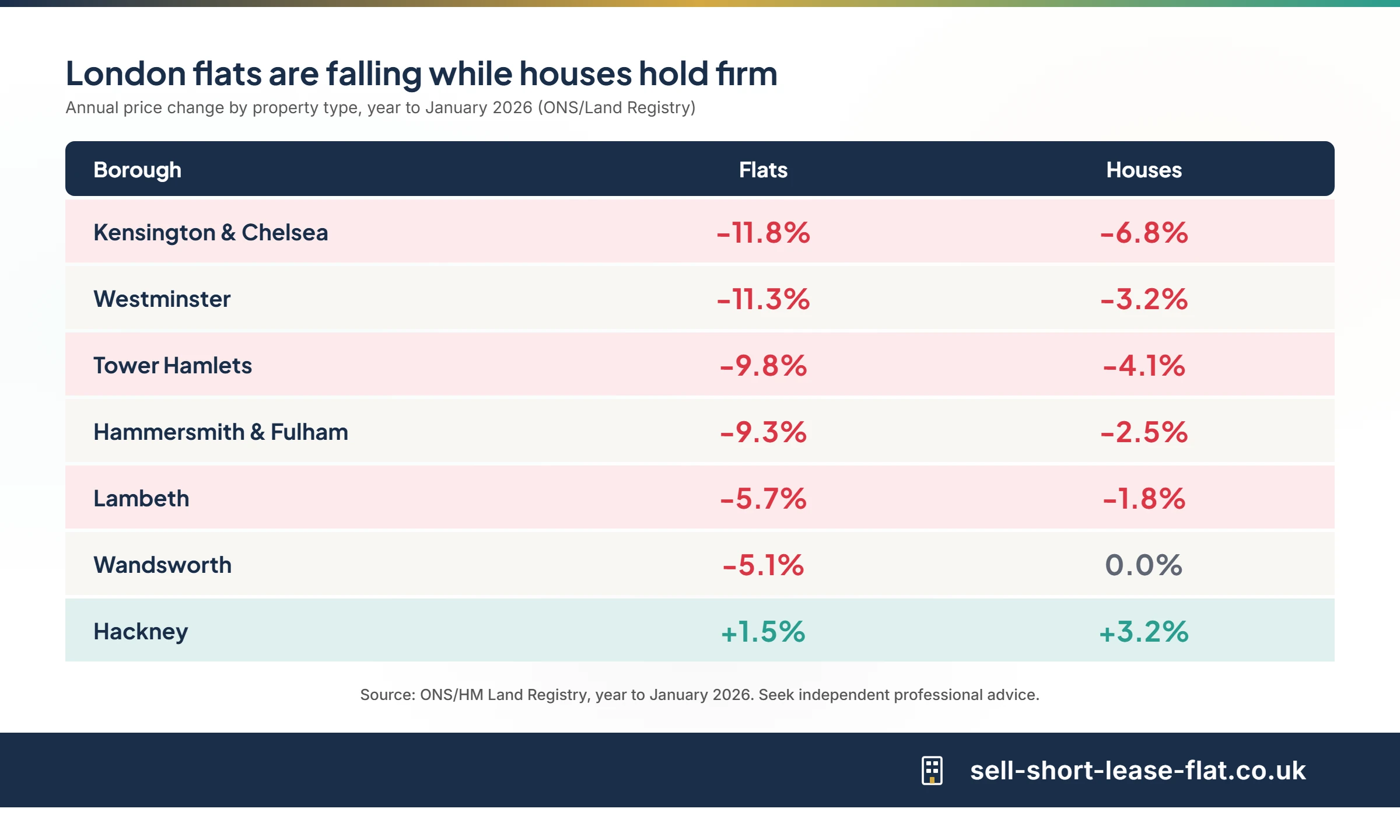
The decline is sharpest in boroughs with high concentrations of leasehold flats and premium pricing:
- Kensington and Chelsea - flats down 11.8%, houses down 6.8%
- Westminster - flats down 11.3%, houses down 3.2%
- Tower Hamlets - flats down 9.8%, houses down 4.1%
- Hammersmith and Fulham - flats down 9.3%, houses down 2.5%
- Lambeth - flats down 5.7%, houses down 1.8%
- Wandsworth - flats down 5.1%, houses flat
The pattern is consistent: in every borough, flats are underperforming houses by a significant margin. The only notable exception is Hackney, where flats rose 1.5% and houses gained 3.2%.
Why flats are underperforming
Several factors are driving the gap, and they are all hitting at once:
- Mortgage affordability - even with the Bank Rate at 3.75%, average mortgage rates have climbed back above 5.5% in April due to geopolitical uncertainty. Monthly payments on London's high-priced flats remain roughly 40% above 2021 levels, pricing out many first-time buyers who traditionally drive flat demand.
- Service charges - London service charges now average around £2,800 per year, with some developments charging £400 or more per month. These ongoing costs make flats less attractive compared to freehold houses with no such obligations.
- Post-Grenfell remediation - buildings with outstanding cladding or fire safety issues continue to weigh on flat valuations, even where the individual flat is unaffected.
- Buyer preference shift - since the pandemic, buyers have consistently favoured space, gardens, and home office potential. Houses deliver all three. Flats, generally, do not.
- Buy-to-let exits - landlords are selling up ahead of the Renters' Rights Act (effective 1 May 2026), adding supply to an already soft flat market.
The double discount for short lease flat owners
If you own a flat with a short lease, you are caught between two forces pulling your property value down simultaneously.
The first is market decline. Your flat is losing value simply because London flats as a category are falling. The second is lease depreciation. Every year that passes on a short lease erodes value at an accelerating rate, particularly below 80 years where marriage value kicks in.
Consider a flat in Westminster worth £500,000 on a long lease with 72 years remaining. The short lease discount alone might be 15-20%, bringing the realistic value to around £400,000-£425,000. Now factor in the 11.3% annual decline in Westminster flat prices, and you are looking at a compounding loss that is difficult to recover from by waiting.
The reforms promised under the Leasehold and Freehold Reform Act 2024 - including marriage value abolition - remain uncommenced. With the freeholder legal challenge now at the Court of Appeal, realistic implementation is unlikely before 2028. That is two more years of declining market values and shrinking lease length.
What should short lease flat owners do?
The data does not suggest a quick recovery for London flats. Most forecasters expect flat growth of 0-2% at best through 2026, with downside risks from further mortgage rate volatility. For short lease owners, the calculus is straightforward:
- If your lease is approaching 80 years - extending now protects you from triggering marriage value. The market decline makes waiting riskier, not safer, because you are losing value on two fronts.
- If you are planning to sell within the next 2-3 years - the combination of falling flat prices and ongoing lease depreciation means earlier action preserves more value than waiting for a market recovery that may not come.
- If you want certainty - a cash buyer who understands short lease valuations can give you a firm offer without the delays, chain breaks, and mortgage complications that are currently slowing the open market.
For a detailed breakdown of how lease length affects value at different thresholds, see our lease length and property value chart. You can also check the full ONS dataset for your specific borough.
If you want to know what your short lease flat is worth in today's market, get in touch. We will give you an honest figure based on current conditions, not last year's prices.