
If you own a London flat with a short lease, the market you are trying to sell into right now is very different from the one that existed three or four years ago. Interest rates have shifted, lending criteria have tightened in some areas and loosened in others, and the long shadow of leasehold reform is changing how buyers value properties with diminishing lease terms.
Here is a clear picture of what is happening in spring 2026 and what it means if you are thinking of selling.
The lending landscape
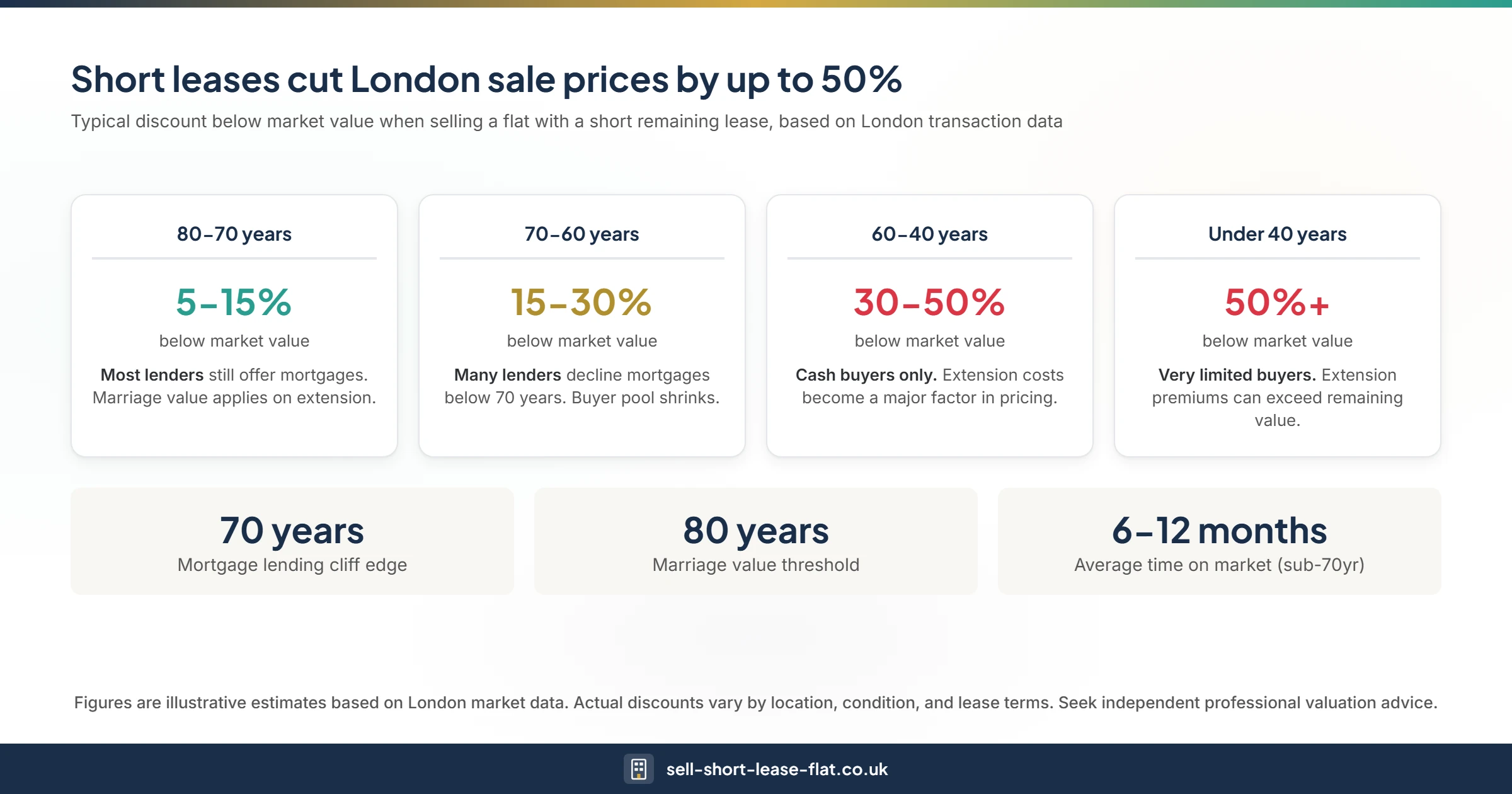
Mortgage availability remains the single biggest factor shaping the short lease flat market. The fundamental problem has not changed: most mainstream lenders will not offer a mortgage on a flat with fewer than 70 years remaining on the lease. Some set the threshold at 80 years. A handful will go as low as 55 years, but with higher rates and stricter terms that put off most buyers.
That lending restriction is what separates the short lease market from the rest of the property market. A two-bedroom flat in Clapham with 90 years left is a normal purchase. The same flat with 65 years left is, for most mortgage-dependent buyers, unbuyable. The physical property is identical. The difference is entirely on paper - and it cuts your buyer pool by roughly 80-90%.
The Bank of England base rate has come down from its 2023-2024 peaks, and mortgage rates have followed. That is good news for the broader property market - more buyers can afford to borrow, and transaction volumes are recovering. But the benefit to short lease flat owners is limited. If your lease is below 70 years, cheaper mortgages do not help much when lenders will not lend at all. The improved affordability is helping the long-lease market far more than the short-lease one, which arguably widens the gap between what your flat could be worth on a long lease and what you can actually achieve.
For flats sitting in the 70-80 year range, there is a modest benefit. Buyers who can secure a mortgage on a flat in this bracket are getting better rates than they would have 18 months ago. But these buyers also know the lease is ticking down, and they negotiate accordingly. For more detail on how this works, see our guide to short leases and mortgages.
What buyers are looking for
With most mortgage buyers out of the picture for sub-70-year leases, the market for short lease flats is dominated by two groups: cash buyers and investors.
Cash buyers include people who have sold a previous property and do not need a mortgage, as well as overseas buyers using funds from abroad. Investors are typically looking to buy at a discount, extend the lease themselves, and either let the property or sell it on at the long-lease value. Both groups understand that a short lease means a lower price - that is precisely why they are interested.
The discount expectations are well established and have not shifted much this year. A flat with 70-80 years remaining typically trades at 5-15% below its long-lease equivalent. At 60-70 years, the discount widens to 15-30%. Below 60 years, sellers should expect offers at 30% or more below the long-lease value. These are not arbitrary numbers - they reflect the cost of extending the lease, the risk involved, and the reduced pool of buyers willing to take on the purchase. Our guide on how a short lease affects your flat's value goes into the maths in more detail.
What is new this spring is the uncertainty around the Leasehold and Freehold Reform Act 2024 (LAFRA). Key provisions - including the abolition of marriage value for leases under 80 years - have still not been brought into force. Buyers do not know whether the rules will change in six months or two years, and that uncertainty is making some more cautious. An investor weighing up a purchase today has to decide whether to price in the current extension cost or gamble on reforms that could reduce it significantly. Many are pricing in the current cost and treating any future savings as a bonus rather than a certainty. That works in their favour, not yours.
Time on market
Short lease flats take longer to sell. That is not speculation - it is a consistent pattern across London boroughs. While the average London flat currently takes around 12-16 weeks to go under offer, short lease properties routinely sit on the market for 6-9 months or longer. Some linger for well over a year.
There are several reasons for this. The reduced buyer pool means fewer viewings. Estate agents who are not experienced with short leases may misprice the property, leading to months of inactivity before a price reduction brings it into the right range. And many potential buyers simply do not understand what a short lease means - they see the price, see the lease length, get confused or worried, and move on.
The longer your flat sits unsold, the more it costs you - and not just in emotional terms. Every month that passes, your lease is one month shorter. That might sound trivial, but the value depreciation on a short lease is not gradual and even. It accelerates as you move down through the critical thresholds. If you start the year at 72 years and sell at 71, the impact is modest. But if you start at 61 years and the sale drags on until you are at 59, you have just crossed below the 60-year mark where the steepest depreciation kicks in.
Speed matters. Not just for convenience, but because delay has a real financial cost.
Your options as a seller
You broadly have three routes to selling a short lease flat, each with trade-offs.
Sell on the open market through an estate agent. This gives you the widest possible exposure and, in theory, the chance to achieve the highest price. The downside is time. As outlined above, you may wait months for the right buyer, and there is no guarantee of completion. Chain breaks, failed mortgage applications, and cold feet are all more common with short lease sales because the transaction is more complex.
Sell at auction. Auction gives you a fixed timeline - typically 28 days from hammer to completion. That speed is valuable. But auction prices are unpredictable. You might get a competitive room with multiple bidders, or you might sell below your reserve on a quiet afternoon. The fees are also higher than a standard sale, and the marketing period before auction adds several weeks to the total timeline.
Sell to a specialist cash buyer. This is the fastest and most certain option. A reputable cash buyer can typically complete in 2-4 weeks with no chain, no mortgage delays, and no risk of the sale falling through. The trade-off is price - cash buyers offer below market value, and they are upfront about that. The discount reflects the speed, certainty, and the fact that they are taking on the lease extension risk themselves. For a detailed comparison of all three approaches, see our guide to selling options compared.
Which route suits you depends on your circumstances. If you have time and can absorb the risk of a longer sale, the open market may get you more. If you need certainty - because you are relocating, going through a separation, dealing with an inherited property, or simply cannot afford to wait while the lease depreciates further - a cash sale removes the uncertainty entirely.
Whatever you decide, getting a clear valuation early is worth doing. It gives you a baseline to compare offers against and helps you make an informed decision rather than a rushed one. You can contact us for a free, no-obligation assessment of your flat's current value.