
When the Leasehold and Freehold Reform Act 2024 received Royal Assent in May 2024, one provision stood out above all others for short lease flat owners: the abolition of marriage value. For anyone with a lease below 80 years, this single change could cut tens of thousands of pounds from the cost of extending. Two years on, it has not happened. The provision remains uncommenced, and there is no confirmed date for when it will take effect.
Here is where things stand, why the delay has happened, and what you should actually do about it.
What is marriage value and why does it matter?
Marriage value is the extra premium you pay when extending a lease that has fallen below 80 years. It represents 50% of the increase in your flat's value that the extension creates. On paper, that sounds reasonable. In practice, it is the single biggest cost in most lease extensions for short lease flats in London.
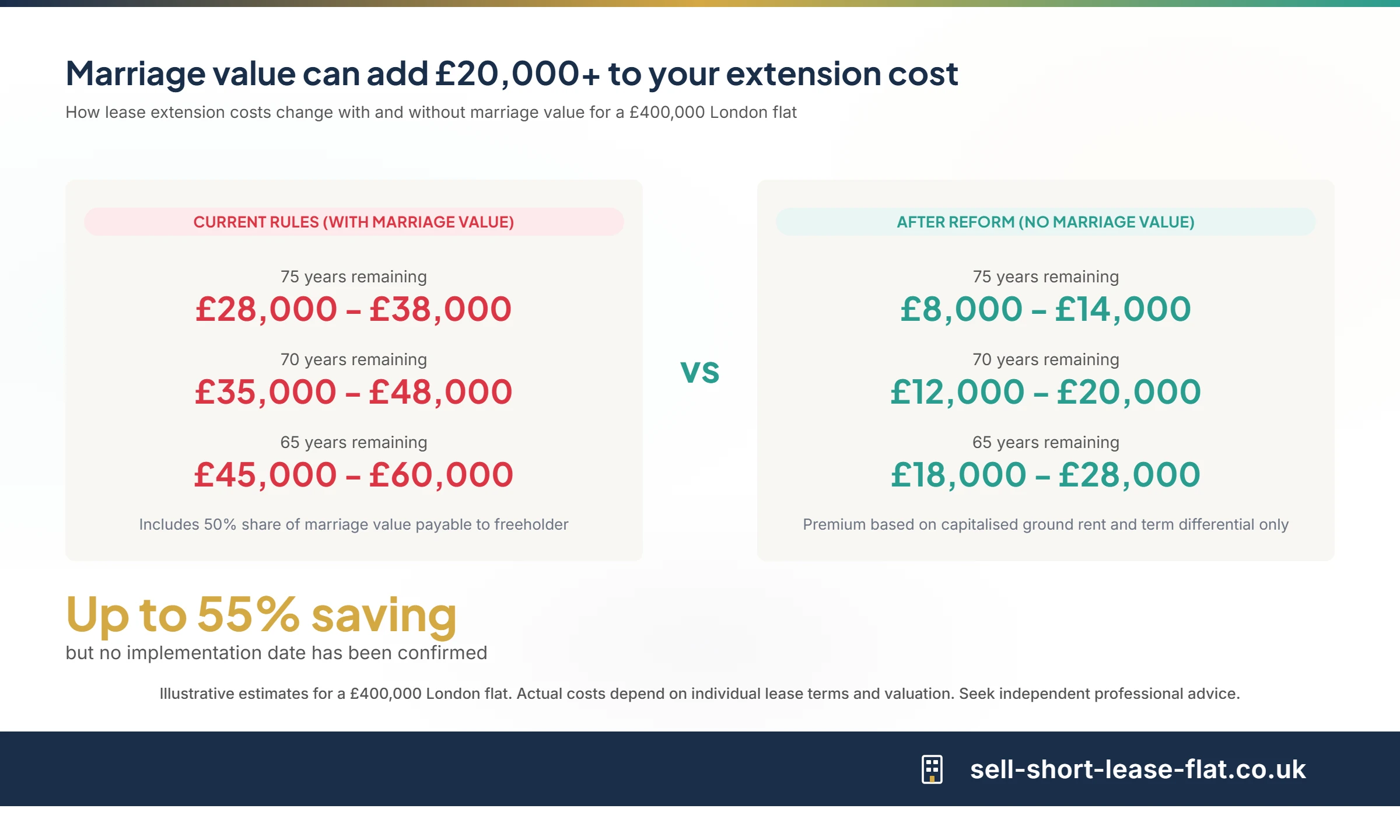
For a London flat worth £400,000 on a long lease with 75 years remaining, the marriage value component alone could be £15,000 to £25,000. At 65 years, it could be £25,000 to £35,000. These are not small numbers. They are the difference between an extension being affordable and being out of reach.
Our full guide to marriage value explains the calculation in detail. The short version: the closer you get to 80 years, and the further you fall below it, the more marriage value you pay. It is a cliff edge in the cost curve that catches many flat owners by surprise.
What the 2024 Act promised
The Leasehold and Freehold Reform Act 2024 included a clear provision to abolish marriage value entirely. Once commenced, no leaseholder extending their lease would have to pay the freeholder's 50% share of the uplift in value. The expected saving for a typical London flat with a sub-80-year lease was estimated at £20,000 to £40,000.
The Act also introduced other changes that would reduce extension costs further: a standardised valuation methodology with prescribed capitalisation and deferment rates, 990-year extension terms (up from 90 years), and automatic ground rent reduction to a peppercorn. Together, these reforms would have made extending a short lease dramatically cheaper.
Why it has not been implemented
The marriage value abolition, along with most of the valuation reforms, requires secondary legislation before it can take effect. That secondary legislation has not been laid before Parliament.
There are three main reasons for the delay:
- Valuation rate consultation - The Government needs to set the prescribed capitalisation and deferment rates that will underpin the new standardised calculation. Getting these rates wrong would either shortchange freeholders (inviting legal challenge) or fail to deliver meaningful savings to leaseholders. The consultation on these rates is ongoing, with no published timeline for a final decision.
- The new Commonhold Bill - In January 2026, the Government published the draft Commonhold and Leasehold Reform Bill, which goes further than the 2024 Act. This Bill includes a £250 annual ground rent cap for existing leases and proposals to make commonhold the default tenure. The Government appears to be folding some of the 2024 Act's uncommenced provisions into this broader legislative programme, rather than commencing them separately.
- Legal and political complexity - A judicial review challenging parts of the 2024 Act was dismissed by the High Court in October 2025, but the threat of further legal challenges from freeholder interests has not gone away. The Government is moving carefully to avoid having key provisions struck down.
Housing minister Matthew Pennycook has stated his determination to "end the leasehold system" within this parliament, but determination is not a commencement order. The draft Commonhold Bill is undergoing pre-legislative scrutiny with consultations running until April 2026. Realistically, the Bill will not enter the formal parliamentary process until late 2026 at the earliest, and it could be 2028 before the ground rent cap and related provisions take effect.
What has actually changed so far
While the headline reforms remain pending, some provisions from the 2024 Act are already in force. The two-year ownership rule was removed in January 2025, meaning you can now serve a Section 42 notice to extend your lease from day one of ownership. Service charge transparency rules and building insurance commission restrictions have also been implemented. These are useful but relatively minor compared to the marriage value abolition.
For a full breakdown of what is and is not in force, see our leasehold reform implementation update.
The cost of waiting
This is where it gets uncomfortable. Every year you wait for reform, your lease gets shorter. And lease depreciation is not a straight line - it accelerates as the lease gets shorter, particularly around the key thresholds:
- 70 to 80 years remaining - a flat typically sells at a 5-15% discount to its long-lease value
- 60 to 70 years remaining - that discount widens to 15-30%, and most mainstream lenders stop offering mortgages
- Below 60 years - expect 30% or more off the long-lease value, with the buyer pool shrinking to cash buyers only
If your lease is at 82 years today and you wait two years for reforms that may not arrive on time, you could cross below 80 years - triggering marriage value under the current rules and adding tens of thousands to your extension cost. That is the worst possible outcome: paying more because you waited for a saving that did not materialise.
Our guide to how lease length affects value shows the full depreciation curve.
What should you do now?
There is no one-size-fits-all answer. Your decision depends on where your lease sits today, how quickly you need to act, and what you can afford.
- Lease above 83 years - You have some breathing room. Marriage value is not yet a factor, and waiting a couple of years carries relatively low risk. But do not forget that your lease is still getting shorter every day.
- Lease between 80 and 83 years - This is the danger zone. Waiting for reform could push you below 80 years, triggering marriage value. Seriously consider extending now to lock in the lower cost.
- Lease below 80 years, not planning to sell soon - You are already paying marriage value under the current rules. If you can afford to wait and absorb the continued depreciation, you stand to save the most when reform arrives. But "when" remains an open question.
- Lease below 80 years and you need to sell - Waiting for reform with no confirmed date is not a strategy. Selling to a specialist buyer who understands short lease valuations may be the most practical option.
If you are unsure where you stand, the Lease Advisory Service offers free initial advice on your options. For a quick estimate of what extending would cost under the current rules, try our lease extension calculator.
The bottom line
Marriage value abolition is coming. The legislation exists. The political will appears genuine. But the implementation timeline remains unclear, and the Government's shift towards the broader Commonhold Bill suggests this could take years rather than months.
For short lease flat owners, the question is not whether reform will happen - it is whether you can afford to wait for it. Every month of delay is another month of lease depreciation. For those close to the 80-year threshold, the maths increasingly favours acting now rather than gambling on a timeline that nobody can confirm.
If you would like to understand what your flat is worth today and what your options are, get in touch. We specialise in short lease flats and can give you an honest assessment with no obligation.