
The Draft Commonhold and Leasehold Reform Bill, published on 27 January 2026, is now in the closing weeks of its pre-legislative consultation. Written responses must reach the Joint Parliamentary Committee by 24 April 2026. After that, the Bill enters a long process of revision, parliamentary stages and secondary legislation, with the Government itself indicating that the headline reforms are unlikely to take effect before late 2028.
For short lease flat owners watching all of this from the sidelines, the consultation deadline is more than a procedural date. It is the point at which the broad shape of the reforms hardens, and where the realistic implementation timetable becomes harder to spin. Here is what is actually being proposed, what it would mean for sub-80-year leases, and how to think about your own position over the next two to three years.
What the Draft Bill actually proposes
The Draft Commonhold and Leasehold Reform Bill is the most significant proposed overhaul of flat ownership in England and Wales for decades. It builds on the Leasehold and Freehold Reform Act 2024, parts of which are still awaiting commencement, and adds several structural changes the previous Act did not deliver.
The headline proposals include:
- A cap on existing ground rents at £250 per year in Greater London and £100 elsewhere, falling to a peppercorn (zero) after 40 years.
- A ban on the creation of new long residential leases, with all new-build flats sold as commonhold instead.
- Replacing forfeiture with a new statutory mechanism that does not allow a freeholder to extinguish a leaseholder's entire interest over a relatively small debt.
- Significant structural reform of the commonhold regime so that it can finally function as a workable alternative to leasehold.
What the Draft Bill does not do is replace the still-pending parts of the 2024 Act. The abolition of marriage value, the move to a 990-year statutory extension and the standard valuation methodology all sit in the earlier Act and are still waiting for commencement orders. Both pieces of legislation are now linked in the public mind, but they are technically separate.
Why the consultation deadline matters
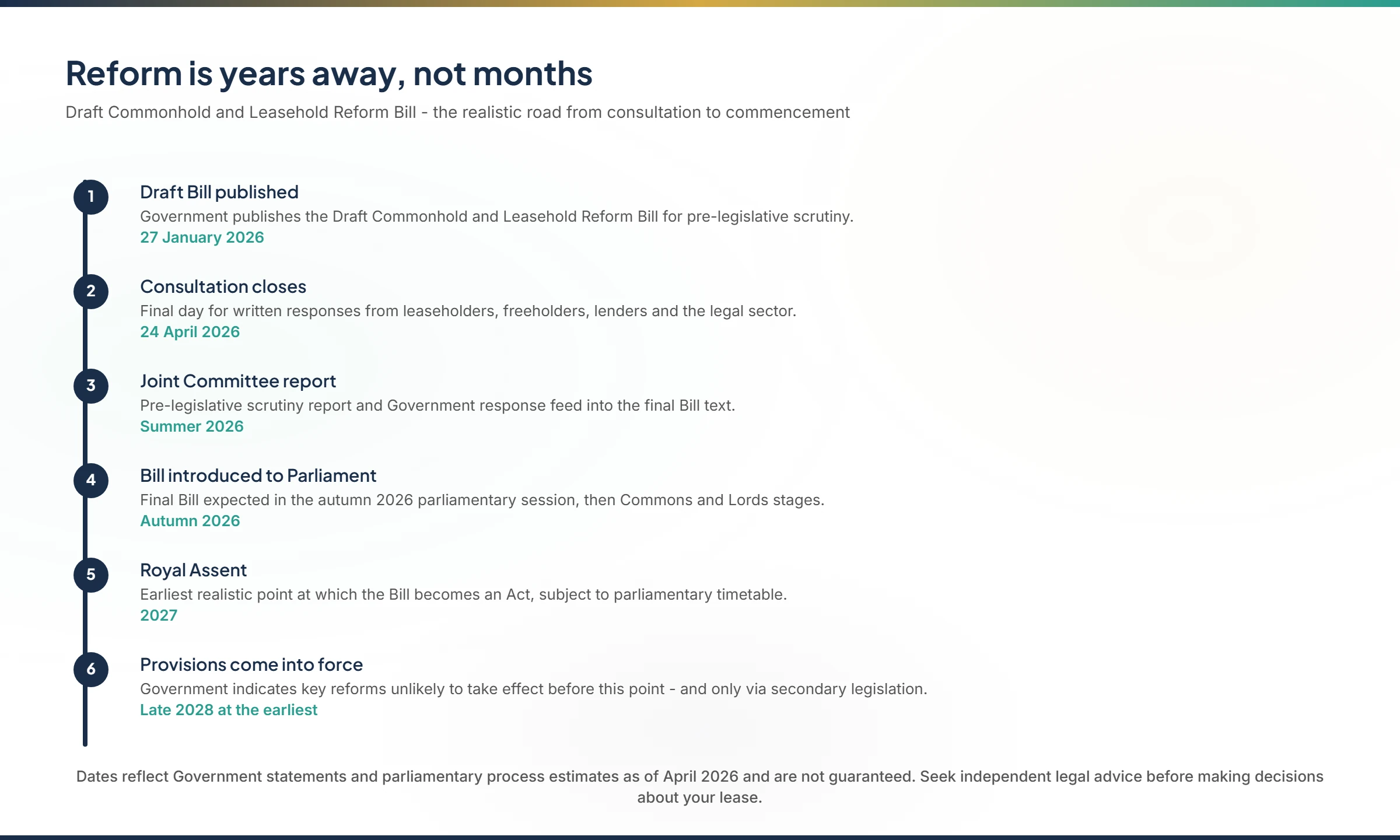
The 24 April deadline closes the formal window for written submissions to the Joint Committee carrying out pre-legislative scrutiny. After that, the Committee produces a report, the Government issues a response, and a final Bill is drafted for introduction to Parliament. The Government has said it expects to introduce the final Bill in the autumn 2026 session.
In practical terms, the closing of the consultation is the point at which the policy direction becomes much harder to reverse. Lobbying from freeholder interests, lender groups and the legal sector concentrates around this window. For leaseholders, it is the last chance to influence the shape of the reforms before they harden into a draft Bill that ministers have to defend in Parliament.
The Leasehold Advisory Service, the Gov.uk consultation page and several leaseholder groups are running structured response templates if you want to add your own voice before the deadline.
The realistic implementation timetable
This is the part the headlines tend to skim over. Even if the consultation closes on schedule and the final Bill is introduced in autumn 2026, the road to commencement is still long.
A Bill introduced in autumn 2026 would normally take the better part of a year to complete its Commons and Lords stages, particularly given the political sensitivity around freehold interests. Royal Assent in 2027 is plausible but not guaranteed. After that, almost every meaningful provision would need secondary legislation to bring it into force, and the Government has indicated that this is unlikely before late 2028. None of this is unusual for a Bill of this size, but it is a long way from the impression some coverage has given that reform is just around the corner.
For short lease flat owners, the gap between political signal and legal reality is the entire problem. Your lease keeps shortening every day the legislation sits in committee.
What this means if your lease is below 80 years
If your lease has already crossed below the 80-year threshold, you are paying marriage value on any extension you complete today. The 2024 Act will eventually abolish marriage value, but as of April 2026 the secondary legislation has not been laid. If you wait for that change, you may save tens of thousands of pounds. If the change is delayed further, you may simply lose more value to a shrinking lease in the meantime.
The price impact is real and accelerates as the lease shortens. Flats with 70 to 80 years remaining typically sell at a 5 to 15 per cent discount to long-lease value. Between 60 and 70 years, the discount widens to 15 to 30 per cent. Below 60 years, you are looking at 30 per cent or more, plus the practical problem that most mainstream lenders will refuse a mortgage entirely.

How to think about your own decision now
There is no single correct answer here. The right move depends on your lease length, your financial position, and how soon you need to act. A few practical guidelines:
- Lease above 80 years but drifting towards it - extending now under the existing rules avoids triggering marriage value. The certainty of locking that in today is often worth more than the possibility of a better deal under reforms with no firm date.
- Lease well below 80 years and no urgency to sell - waiting may be sensible if you can absorb continued depreciation. Marriage value abolition will save you the most in this bracket, but only if and when it actually arrives.
- Lease below 80 years and you need to sell - waiting for late 2028 reform is not realistic if you need to move sooner. The most practical route is usually to talk to a buyer who specialises in short leases and can complete without a chain.
If you want to compare your options in detail, our guide to selling options compared walks through estate agent, auction, extending first and direct sale. Our guide to buying the freehold versus extending covers the alternative routes when collective enfranchisement is on the table.
For the latest position on which provisions of the 2024 Act are already in force, see our breakdown of LAFRA implementation. You can also follow official updates on the Gov.uk leasehold reform collection and the Leasehold Advisory Service.
If you would like a clear, honest valuation of where your flat stands today - regardless of which reforms eventually land - get in touch. We specialise in short lease flats across London and the rest of the UK, and there is no obligation either way.