
Housing and Planning Minister Matthew Pennycook delivered a keynote speech at the Institute for Government on 29 April 2026 in which he conceded, for the first time on the public record, that the proposed ban on new leasehold flats is "highly likely" not to switch on before the next general election. He also confirmed that ground rents on existing leases will fall to a peppercorn only after a 40-year transition, and that immediate abolition of leasehold in its entirety would be "almost certainly impossible".
For short lease flat owners who have been watching the reform timeline drift since the Leasehold and Freehold Reform Act 2024 (LAFRA) received Royal Assent two years ago, this is the clearest official signal yet that the timing is slipping further. Here is what the minister actually said, what it means for sub-80-year leases, and how to think about your own position when the headline reforms are not coming any time soon.
What the minister actually said
The speech, delivered to a packed audience at the Institute for Government in Carlton Gardens, was framed as a progress update on both the still-pending parts of LAFRA and the Draft Commonhold and Leasehold Reform Bill. The full text is published on the Gov.uk website.
Three lines stood out for short lease flat owners:
- "Highly likely" no ban this Parliament. On the new-flat leasehold ban, the minister said: "I'm not saying there's no chance, but I think it's highly likely that we don't switch on the ban in this parliament." That is a meaningful shift from the political signalling of the past two years.
- 40-year taper to peppercorn. The cap on existing ground rents will be set at £250 a year initially, "transitioning to a 0 peppercorn value over the next 40 years". For a leaseholder paying £500 a year today, that is half off, but the full peppercorn outcome only lands around 2066.
- Outright abolition off the table. The minister was direct that abolishing roughly five million existing leases overnight is "almost certainly impossible", citing the mortgage market, the Land Registry, and the practical problem of standing up millions of new commonhold associations. He described immediate abolition as "a glib soundbite rather than a serious policy proposition".
None of this changes the policy direction. Commonhold is still being made the default for new flats, ground rents are still being capped, and forfeiture is still being replaced. What has shifted is the timetable - and how candidly the Government is now willing to talk about it.
How the timeline has stretched
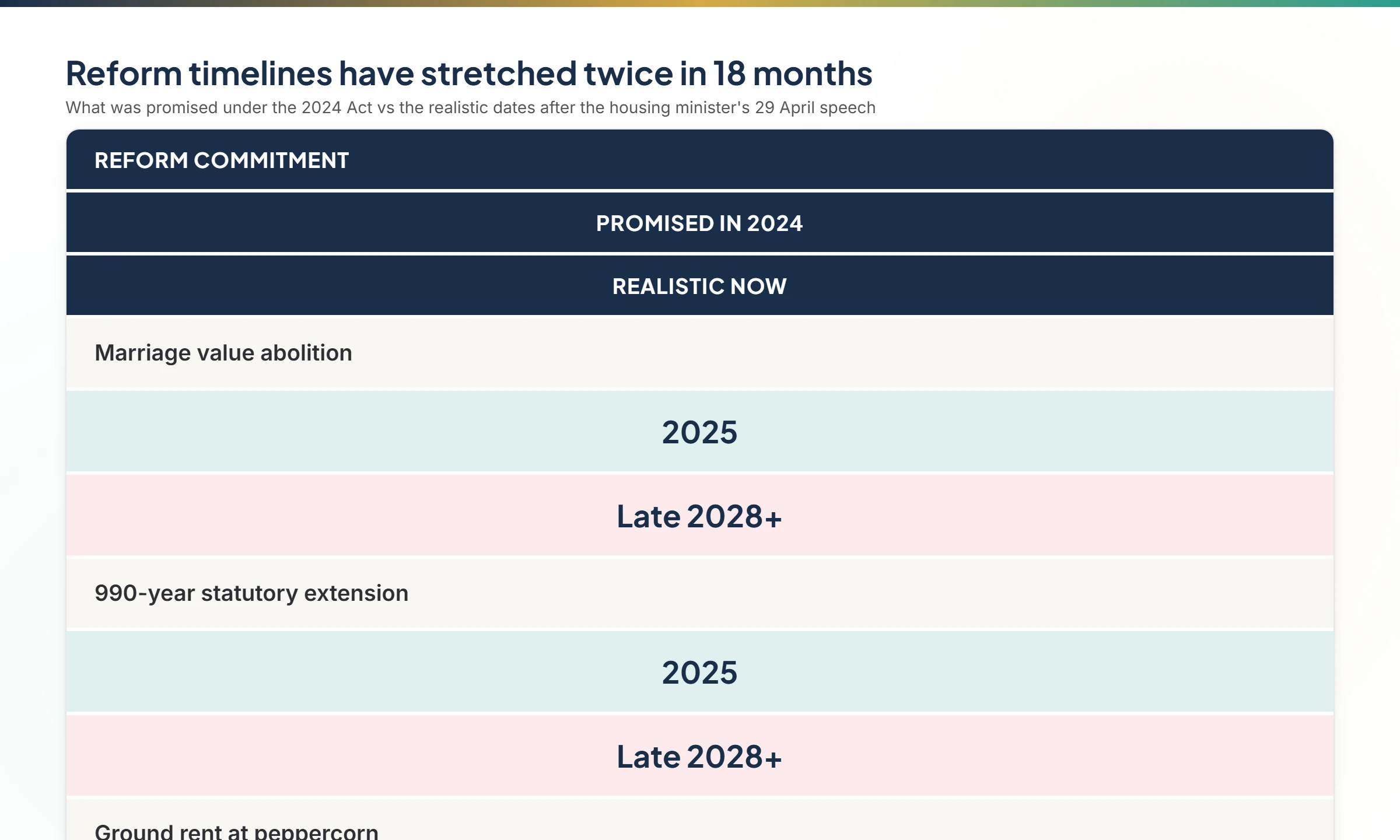
For anyone who has not been following month by month, it is worth stepping back and looking at how the dates have moved. In May 2024, when LAFRA received Royal Assent, the working assumption across the sector was that marriage value abolition and the 990-year statutory extension would be live by some point in 2025. They are still not in force. The Draft Commonhold and Leasehold Reform Bill, published in January 2026, was meant to add structural reforms on top of LAFRA - the new-flat ban, the ground rent transition, the commonhold default. The Government's own current estimate is that the headline provisions of that Bill will not come into force before late 2028.
Yesterday's speech effectively pushed the new-flat ban beyond that again, into the next Parliament. For sellers of existing short lease flats, the practical impact is muted - the ban affects new builds, not your flat - but it underlines how slowly all of this is moving.
What this means for short lease owners
The new-flat ban is the headline that gets the press coverage, but it is not the part of the reform package that affects your flat if it already exists. The provisions that actually matter to a sub-80-year leaseholder are sitting in two earlier moves: the still-uncommenced parts of LAFRA, and the ground rent cap proposed in the draft Bill.
If your lease is below 80 years today, you are paying marriage value on any extension you complete now. LAFRA is supposed to remove marriage value, but its commencement date keeps moving. Pennycook did not set out a fresh date for marriage value abolition in the speech, beyond pointing to the 2028 implementation window.
If your ground rent is one of the modern doubling clauses, the £250 cap will help when it eventually arrives. But the full peppercorn outcome that some leaseholders have been hoping for is now formally a 40-year journey. Most short lease owners are not in a position to wait four decades.
The blunt reading is this: every reform that would meaningfully improve your position as a short lease seller has been pushed further out, and the minister has now publicly accepted that. The political will is real - but the legal mechanics, the lender consequences and the parliamentary timetable are not bending to it.

The "wait or sell" question, refreshed
This speech does not change the maths of selling a short lease flat. It changes the assumptions around how long you can sensibly wait. A few practical reads:
- Lease above 80 years and drifting down. Extending now under the existing rules avoids triggering marriage value at all. The certainty of locking that in today is usually worth more than the chance of a better deal under reforms with no firm date.
- Lease in the 70-80 year range. You are still inside the 5-15 per cent discount band when selling. Waiting for marriage value abolition could save real money, but the 2028 implementation window is now the floor, not the ceiling. If you need to move sooner, the realistic options are extending the lease yourself or selling to a buyer who specialises in short leases.
- Lease below 70 years. Mainstream lenders mostly will not lend, the discount widens to 15-30 per cent, and the depreciation accelerates as you approach 60. Waiting four years for legislation while the lease ticks down is a difficult trade. Our guide on how a short lease affects your flat's value has the numbers.
- Lease below 60 years. The structural reforms will not arrive in time to prevent further depreciation. The realistic routes are to extend the lease, buy the freehold collectively, or sell to a cash buyer who can complete without a chain.
It is worth saying that none of this is a reason to panic, and none of it is a reason to accept a poor offer. It is a reason to plan with the actual timeline in front of you, rather than the one some campaign groups were promising last year. For a fuller view of which provisions are actually in force, see our breakdown of LAFRA implementation, and our earlier piece on why marriage value abolition has stalled.
Where to read more
The official record of the speech is on Gov.uk. The Leasehold Advisory Service publishes plain-English fact sheets on extension rights and is updating its 2026 commencement guidance as new orders are laid. The Gov.uk leasehold reform collection is the easiest single page to bookmark for ongoing updates. For the wider context, our guide to the Leasehold and Freehold Reform Act 2024 walks through the Act provision by provision.
If you would like an honest valuation of what your short lease flat is worth right now, against the timeline as it actually stands rather than the one that was once hoped for, get in touch. We specialise in short lease flats across London and the rest of the UK, and there is no obligation either way. Our step-by-step guide to selling a short lease flat covers what to expect end to end.