If you are trying to sell a short lease flat, the service charge is often the second thing a buyer asks about, right after the lease length. A bill that is high, or impossible to make sense of, can put people off before they ever reach the survey. So the package of service charge rules the Government confirmed on 15 July 2026 matters to you, even though most of it does not take effect until 2027.
The rules sit under the Leasehold and Freehold Reform Act 2024 (LAFRA), the same Act behind the marriage value and lease extension changes still waiting to commence. This time the detail is firmer. Here is what was confirmed, what changes and when, and what it means if you are weighing up a sale.
What the Government confirmed
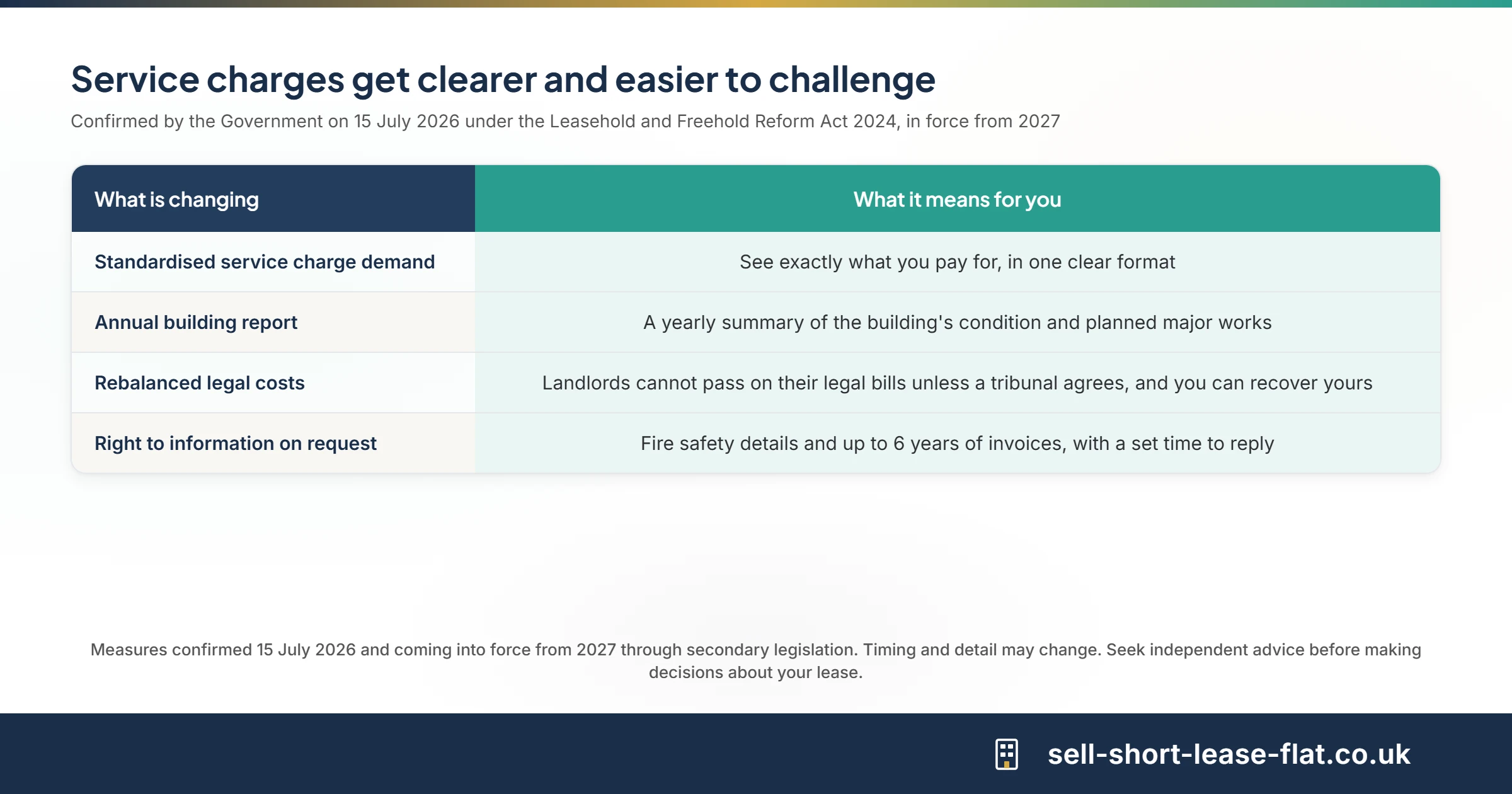
On 15 July 2026 the Government published its response to the consultation on strengthening leaseholder protections over charges and services. Four changes stand out:
- A standardised service charge demand. Landlords will have to set out charges in a single prescribed format, so you can see what you are paying for instead of decoding a one-line bill.
- An annual building report. Once a year you get a summary of the building's condition, any planned major works, and the information you need to track what is happening to your money.
- Rebalanced legal costs. A freeholder will no longer be able to pass their legal costs to you as a service charge unless a tribunal agrees it is reasonable, and you will be able to recover your own costs when you win.
- A right to information on request. Fire safety details and up to six years of invoices must be handed over within a set time, so a demand can actually be checked.
Housing Minister Matthew Pennycook said the aim is to strengthen protections "in the here and now by driving up service charge transparency and rebalancing legal costs so that leaseholders are empowered to challenge unreasonable charges".
What changes today
Nothing on your next service charge demand. The Government has confirmed the measures but not switched them on. They come into force from 2027, through a series of statutory instruments, and landlords and managing agents will be given notice to prepare. This is a firm direction of travel, not a bill you can challenge differently tomorrow.
If your service charge looks unreasonable now, the existing routes still apply: you can ask the freeholder for a summary of costs and, if it is not resolved, challenge the charge at the First-tier Tribunal. Our piece on the earlier City Hall review of London service charges covers how sharply those bills have climbed.
Why it matters when you are selling
Service charges have become a real drag on flat sales. The average London service charge now runs to about £2,801 a year, according to Hamptons, and a high or opaque charge narrows the pool of buyers who will proceed. Clearer, challengeable charges should ease that over time, because a buyer can see exactly what they are taking on.
For a short lease flat, though, the service charge is only one of two problems. The lease length is the other, and these rules do not touch it. A flat with a tidy, transparent service charge and a 68-year lease is still a flat most lenders will not mortgage. Our guide on how a short lease affects value sets out where the discounts bite.

The other half of the announcement
The 15 July package came with something that speaks more directly to short lease owners: two consultations on the cost of extending a lease or buying the freehold. The Government is asking how to set the prescribed valuation rates that will decide those premiums, and how to protect leaseholders from paying the freeholder's process costs. Those rates are the mechanism that will deliver, or dilute, the marriage value abolition that LAFRA promised. Until they are set and commenced, marriage value is still payable on any lease under 80 years, and the current rules still apply to every extension. Our guide to marriage value explains why that figure matters so much below 80 years.
What it means if you own a short lease flat
The service charge rules are welcome, but they do not change the lease maths. A few honest reads by lease length:
- Above 80 years. You have time. Keep your service charge demands and any challenge records tidy, because a clean, well-run building sells better whatever happens with the lease.
- Between 70 and 80 years. Extending now avoids triggering marriage value, and clearer charges make the flat easier to sell either way. Expect roughly a 5% to 15% discount to a long-lease equivalent if you sell as is.
- Between 60 and 70 years. Most mainstream lenders step back under 70 years, so your buyers are mainly cash buyers and investors, and the discount widens to around 15% to 30%. Transparency on charges helps at the margins; it does not fix the mortgage problem.
- Under 60 years. The discount can pass 30%, and none of the 2027 changes will move that. The realistic options are the same: extend the lease, buy the freehold with other leaseholders, or sell to a cash buyer. Our guide to your selling options compared weighs them up.
Better service charge rules make a leasehold flat easier to own and easier to sell. They do not stop a lease shortening, and the premium to fix that climbs every year you wait.
Where to read more
The Government's announcement is on Gov.uk, and the detail sits with the charges and services consultation. The Leasehold Advisory Service explains your current rights on service charges and building management. For where the wider reform stands, see our piece on MPs pushing the Government to go further and faster.
If you want a straight view of what your short lease flat is worth today, service charge and all, get in touch. We buy short lease flats across London and the rest of the UK, with no obligation either way.