The Commonhold and Leasehold Reform Bill was named in the King's Speech on 13 May 2026, formally entering the legislative programme for this parliamentary session. The Bill puts on a statutory footing the headline reforms ministers have been promising for the past two years - a £250 cap on existing ground rents reducing to a peppercorn over 40 years, abolition of forfeiture, and commonhold as the default tenure for new flats. It also introduces a new statutory right for flat owners to request a gigabit broadband connection, added on the same day.
For anyone who has been following leasehold reform since 2012, this was not a small moment. The Leasehold Knowledge Partnership marked the speech as the end of 14 years of campaigning to get commonhold into a King's Speech at all. For short lease flat owners, however, the more practical question is what changes today, what changes in 2028 or 2029, and what the Bill still does not address.
What the Bill actually contains
The Bill is the legislative vehicle for both the still-uncommenced parts of the Leasehold and Freehold Reform Act 2024 (LAFRA) and the further structural reforms that LAFRA did not deliver. Confirmed in the Speech and the accompanying briefing pack, the headline provisions are:
- Existing ground rents capped at £250 a year. The cap will then taper to a peppercorn (zero) over a 40-year transition. Government expects the cap to commence in 2028.
- Forfeiture abolished. The current power for a freeholder to extinguish a leaseholder's entire interest over a relatively small debt will be replaced with a proportionate statutory enforcement scheme.
- Commonhold as default for new flats. Granting new long leases of flats will be restricted by statute, with commonhold expected to be the default tenure by 2029.
- Remaining LAFRA provisions to commence. The Bill is the route through which marriage value abolition, the 990-year statutory extension and the standardised valuation methodology are expected to be brought into force.
- New right to request gigabit broadband. Added on 13 May. Flat owners gain a statutory right to request a faster connection from their freeholder, affecting more than 500,000 flats currently without gigabit coverage.
The Bill does not include an immediate ban on new leasehold flats, despite that being part of the policy direction. Housing Minister Matthew Pennycook restated last month that switching the ban on this Parliament is "highly likely" not to happen. We covered that pivot in our piece on Pennycook's 29 April speech.
14 years to get here
The reason this moment carries weight in the leaseholder press is the length of the runway. The Law Commission's first commonhold consultation started in 2012. Its final report - effectively the blueprint for what is now in the Bill - was published in 2020. LAFRA passed in 2024 but left the structural reforms (ground rent cap, commonhold default, forfeiture abolition) for a second piece of legislation. The draft of that second Bill was published on 27 January 2026, ran through pre-legislative consultation that closed on 24 April, and has now been formally tabled.
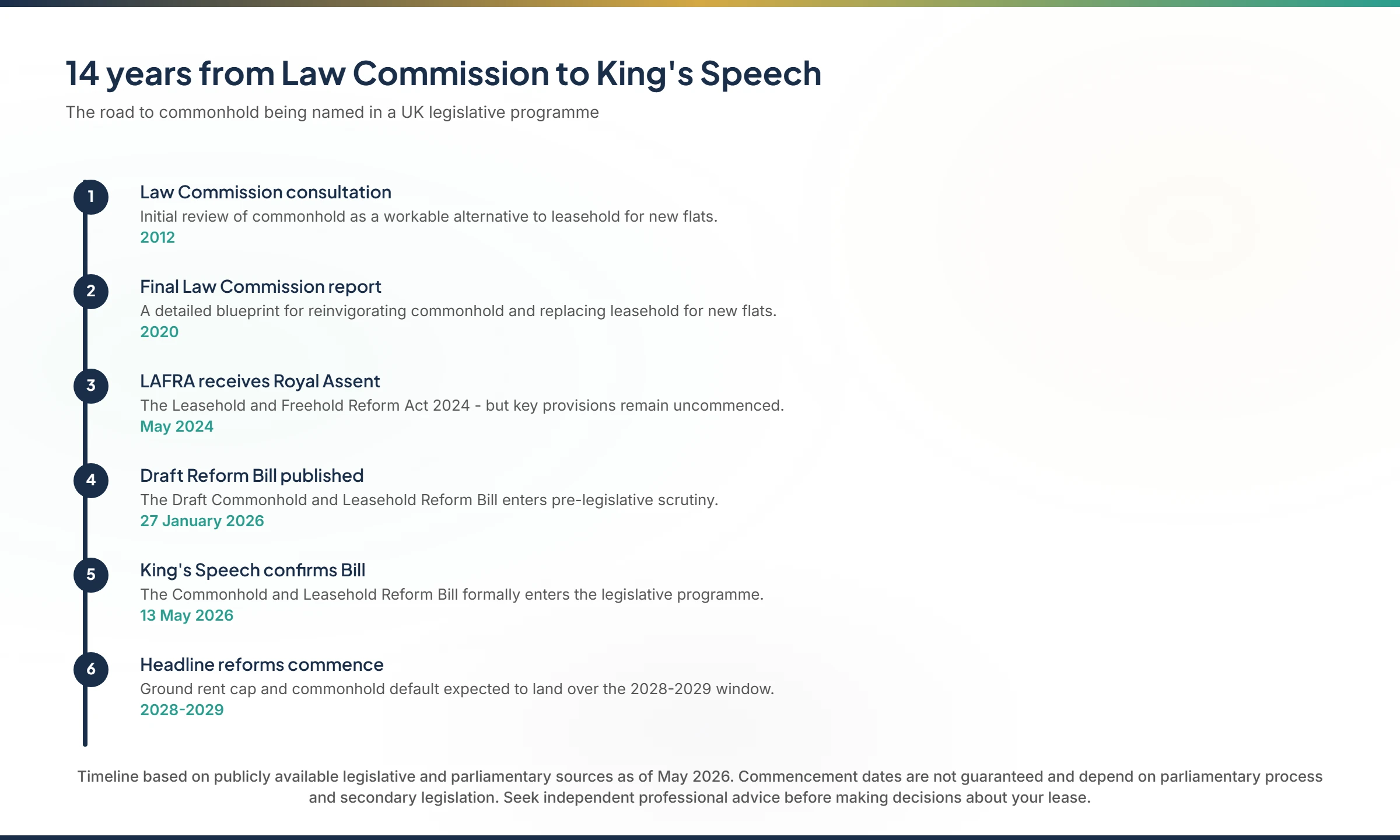
For context, the consultation that fed into the Bill ran from January to April this year. Our earlier piece on the consultation closing on 24 April set out what was actually being asked. The King's Speech is the moment that closes off the consultation phase and starts the parliamentary stages proper.
What it changes today
Nothing on your next service charge demand. Nothing on a sale you complete this week. The King's Speech does not commence any provision of the Bill - it confirms the intention to legislate. The Bill must now pass Commons and Lords stages, receive Royal Assent, and then almost every meaningful provision will need a separate commencement order. The Government's own working estimate is that the headline reforms land in the 2028-2029 window, with the ground rent cap pencilled in for 2028 and commonhold default for 2029.
What it does change is the political risk profile. With the Bill formally in the legislative programme, the question is no longer whether the reforms will be tabled, but when they will be enacted and whether they survive parliamentary amendment. The freeholder coalition that lost its judicial review against LAFRA in October 2025, and whose Court of Appeal challenge is still running, has a narrower target now - the existing Bill, with a clear House of Commons majority behind it.
What this means if you own a short lease flat
The strategic question is unchanged. Marriage value abolition is still pending and still relevant: leases below 80 years still pay it on extension today, and may save tens of thousands when the commencement order finally lands. But the timeline for "finally" is now formally a 2028-2029 window, not a 2025-2026 hope. A few practical reads:
- Lease above 80 years and drifting down. Extending now under existing rules avoids triggering marriage value altogether. The certainty of locking that in today is usually worth more than the chance of a slightly cheaper extension under reforms that are still three years from coming into force.
- Lease between 70 and 80 years. Waiting could save real money on the eventual extension premium, but the holding cost is two more years of lease depreciation plus exposure to whatever happens in the London flat market in the meantime. Our guide to marriage value walks through the calculation in detail.
- Lease below 70 years. Mainstream lenders mostly will not lend, the buyer pool is dominated by cash buyers and investors, and the depreciation accelerates as you approach 60. Waiting four years for legislation while the lease ticks down is rarely the right call.
- Lease below 60 years. The structural reforms will not arrive in time to materially reduce your discount. Realistic options remain extending the lease, buying the freehold collectively, or selling to a cash buyer. See our step-by-step guide to selling a short lease flat.

Where to read more
The full text of the Speech and the accompanying briefing pack are published on Gov.uk. The Ministry of Housing, Communities and Local Government summary of the leasehold reform measures is on the MHCLG media blog. The House of Lords Library briefing sets out the housing measures in detail. For ongoing implementation tracking, our breakdown of LAFRA provisions in force is updated as commencement orders are laid. Since this piece was published, MPs have scrutinised the draft Bill and pushed for a quicker timetable, which we cover in MPs tell ministers to go further and faster on leasehold reform.
If you would like an honest valuation of where your short lease flat stands today, taking account of the actual reform timeline rather than the one some headlines suggested, get in touch. We specialise in short lease flats across London and the rest of the UK, with no obligation either way.