
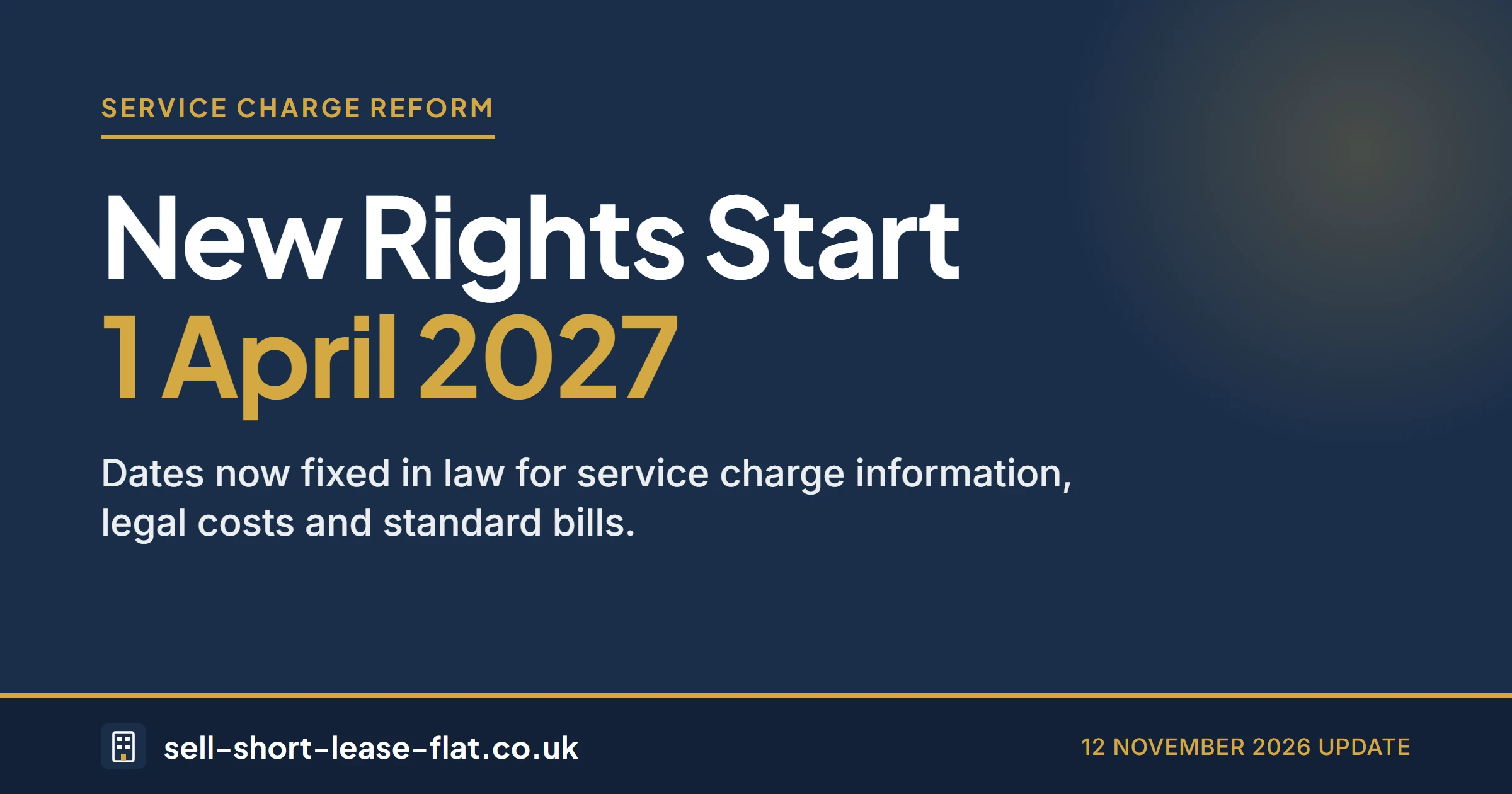
If you plan to sell your flat in the next year or two, the service charge rules your buyer's solicitor works with now have fixed dates. On 25 October 2026 the Government made the regulations that switch on most of the service charge part of the Leasehold and Freehold Reform Act 2024 (LAFRA). On 11 November it confirmed that the first changes you will notice arrive on 1 April 2027, and five more sets of regulations went before Parliament the next day.
Two things the package does not do. It does not cap service charges, and it does nothing to your lease length. A flat with 65 years left will be no easier to mortgage in April 2027 than it is today.
What has been set, and when
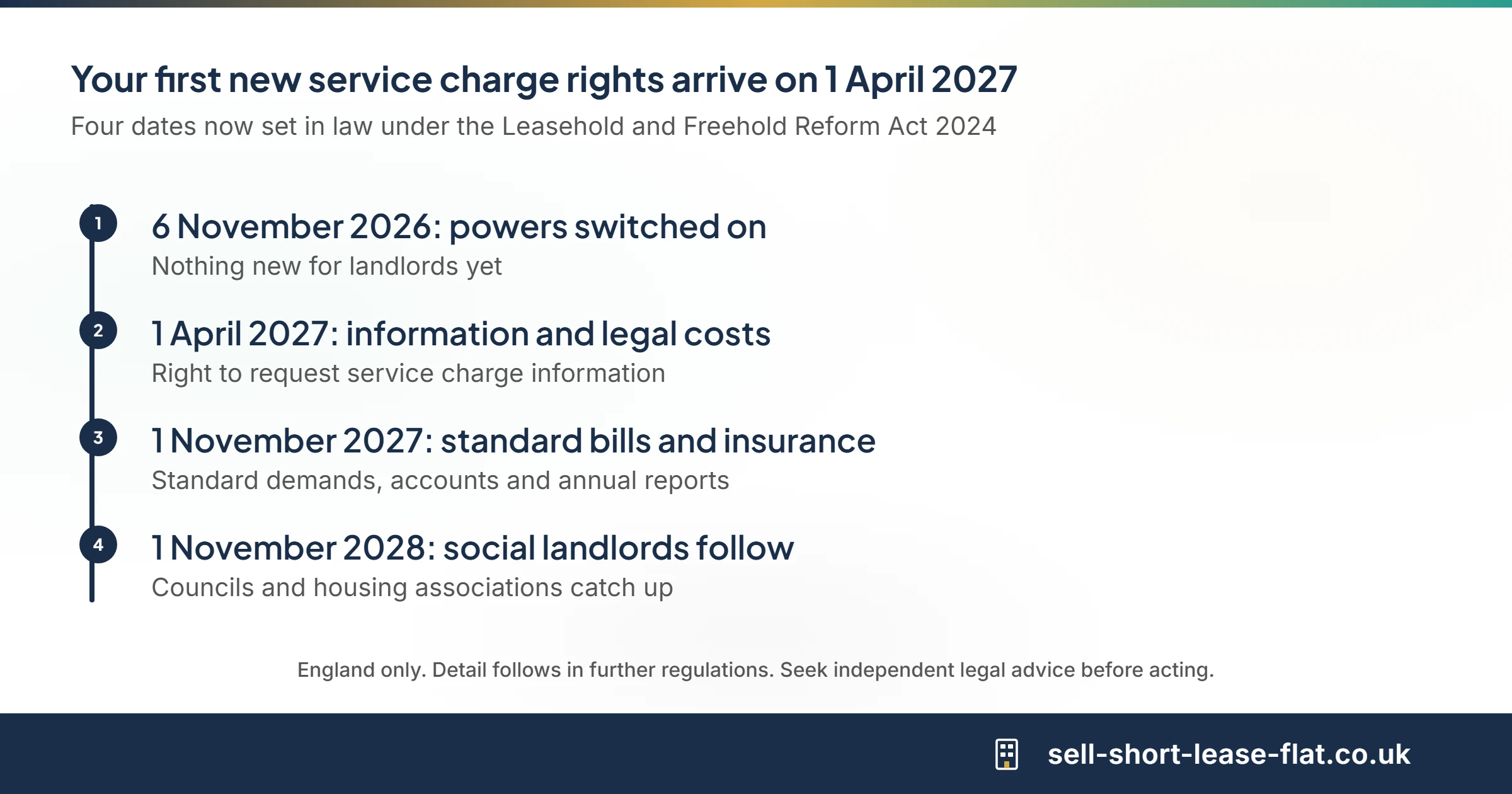
The instrument is the Leasehold and Freehold Reform Act 2024 (Commencement No. 4 and Saving Provision) (England) Regulations 2026, SI 2026/1128. It brings the changes in over four dates:
- 6 November 2026. Powers only. The Government can now set the detailed forms, content and deadlines. Nothing changes on your bill.
- 1 April 2027. You can request service charge and management information, including for previous years, and the landlord needs a good reason to refuse. A freeholder will need court or tribunal approval before passing their legal costs on to you, and you gain a route to recover your own. A prescribed "future demand notice" replaces the current 18-month warning under section 20B for costs not billed in time, and fixed service charges come within the statutory rules for the first time.
- 1 November 2027. Private landlords must use standard demand forms and provide accounts and an annual report. You get set information on building insurance, landlords can no longer recover "excluded insurance costs" through the service charge, and they must publish a schedule of administration charges.
- 1 November 2028. Councils and housing associations follow on demands, accounts and reports.
Each change applies to existing leases as well as new ones, in England only. The legal costs rules will not apply to proceedings issued before 1 April 2027, and one more set of regulations on litigation costs is due before the end of 2026. Kion Ahadi, chief executive of the Leasehold Advisory Service, said in the Government's announcement that "service charges are the most common issue leaseholders contact us about".
What changes today
Nothing on your next demand. Until 1 April 2027 the current rules apply: you can ask the freeholder for a written summary of costs, the 18-month rule under section 20B still limits late bills, and you can challenge an unreasonable charge at the First-tier Tribunal. The Leasehold Advisory Service sets out how those routes work now.
If you are already in a dispute with your freeholder, the new legal costs protection only covers proceedings issued on or after 1 April 2027. Speak to a solicitor before you start one.
Why the dates matter if you are selling
When you sell a leasehold flat, your buyer's solicitor sends leasehold enquiries about the service charge: what you have paid, what is planned and whether anything is disputed. Today, a freeholder or managing agent who is slow to supply that information can hold up a sale for weeks. From April 2027 you have a statutory right to the information, and from November 2027 the standard demands and annual reports should give buyers a cleaner paper trail to read. Both should make the pack easier to put together.
None of that changes the bigger question on a short lease. Under 80 years, marriage value is still payable on an extension. Under 70, most mainstream lenders decline to lend. The valuation rates that will set extension premiums under LAFRA are still undecided, and the consultation on them closed on 21 October 2026 with no outcome yet. The Commonhold and Leasehold Reform Bill, which would cap existing ground rents at £250 a year, is due in Parliament before Christmas, but it is not law. Our earlier piece on the service charge rules confirmed in July covers what the new demands and reports will look like.

What it means if you own a short lease flat
The honest read is that these dates help with the paperwork of a sale, not the price. By lease length:
- Above 80 years. You have time. Keep every demand and any correspondence about charges, and once April 2027 arrives, use the new right to fill gaps in your records before you list.
- Between 70 and 80 years. The date your lease crosses 80 matters more than any date in this timetable. Expect roughly a 5% to 15% discount to a long-lease flat if you sell as is. Our guide to marriage value shows how the extension cost jumps below 80.
- Between 60 and 70 years. Your buyers are mainly cash buyers and investors, because most lenders step back under 70, and the discount runs at around 15% to 30%. Clear service charge records help those buyers make a decision. See our guide to short leases and mortgages.
- Under 60 years. The discount can pass 30%, and nothing on this timetable moves it. The options are to extend under the current rules, buy the freehold with your neighbours, or sell to a buyer who does not need a mortgage. Our selling options guide compares them.
Where to read more
The Government's announcement, Flat owners handed massive boost to fight rip-off service charges, is on Gov.uk. For the wider picture, see our guide to the Leasehold and Freehold Reform Act 2024 and our step-by-step guide on how to sell a short lease flat.
If you want to know what your flat is worth today, service charge and lease length included, get in touch for a free, no-obligation valuation. Our cash offer will be below what a long-lease flat would fetch on the open market. In return, the sale completes in weeks, with no chain and no mortgage for a lender to refuse.